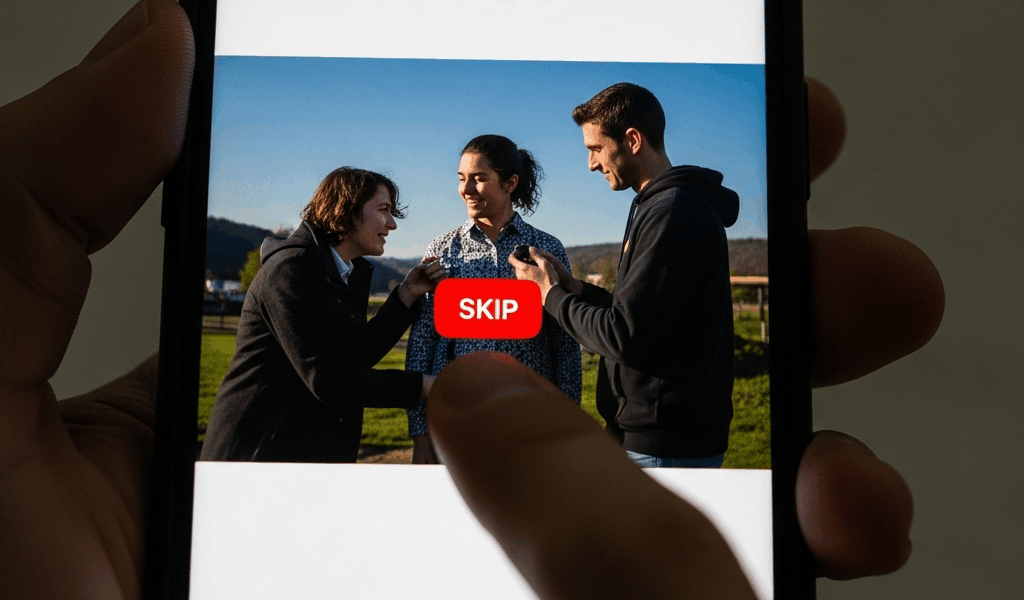
The Skip Happens Before You Think It Does
YouTube Shorts retention has gotten complicated with all the conflicting advice flying around. As someone who spent three months buried in Shorts analytics — obsessively pulling retention curves at 11pm on weeknights — I learned everything there is to know about why viewers bail in under two seconds. Today, I will share it all with you.
Here’s the part that genuinely surprised me: I’d spent weeks perfecting my opening line. Rewrote it probably a dozen times. Practiced the delivery. Then I checked the data and realized most of my viewers never heard a single word of it. Not because it was bad. Because they were already gone.
YouTube’s Shorts feed auto-plays with sound off for a significant chunk of your audience. So your first one to two seconds gets judged entirely on visuals. No dialogue. No clever hook. No context. Just whatever the viewer sees the moment playback starts — and their brain decides in roughly 600 milliseconds whether to stay or swipe.
A blurry first frame reads as cheap, instantly. A dark opening registers as boring before the conscious mind has even processed what it’s looking at. A static image that looks like a paused video? Gone. And the algorithm watches every one of those micro-exits pile up before quietly stopping your distribution.
Most creators pour energy into hook quality — the words, the premise, the story setup. But the real problem lives in frames zero through two. Before language enters the equation at all.
Dead-Air Openers Are Killing Your Retention
Probably should have opened with this section, honestly — because watching your own Shorts with the sound completely off is the first diagnostic most creators actually need and almost none of them do.
The most common mistake I keep seeing: the video opens with silence. A logo animation. A two-second transition. The creator still adjusting their ring light at $34.99 from Amazon. Something — anything — that isn’t immediate, relevant motion or a compelling visual reason to stay.
Here’s the number that changed how I edit everything. If your first spoken word hits at 0.8 seconds into the video, you’ve already lost roughly 30 percent of viewers. Not because they’re impatient or unreasonable. Because they had nothing to look at that signaled “stay.” YouTube’s own research shows creators who front-load visual information in the first half-second see measurably higher completion rates. Half. A. Second.
So what belongs in frame zero? Motion. A face mid-expression — genuine confusion, excitement, something that reads as human and alive. Text overlaid on the opening frame that teases the payoff without spelling it out. Your subject dead-center in the frame, large and obvious, not tucked into a corner like an afterthought. The action already happening, not building toward happening.
I ran a test series about three months back. One opener had me looking visibly confused while text read “This broke my algorithm.” Another started with a 0.3-second pause — just me about to speak. That half-second of silence cut my average retention by 18 percent across ten uploads. Don’t make my mistake. The pause wasn’t adding suspense. It was signaling dead air to every viewer’s subconscious.
To audit your own content: pull up your last five Shorts and watch each one muted. Ask yourself honestly — would you swipe on this within two seconds if it showed up on your feed with no sound? If the answer is anything except “yes, immediately,” the opener needs work.
Visual Problems That Trigger Instant Swipes
Beyond opener timing, there are specific visual mistakes baked into Shorts that creators repeat across dozens of uploads without ever realizing it.
But what is a “bad first frame,” exactly? In essence, it’s any visual that fails to give the viewer’s eye somewhere meaningful to land. But it’s much more than that — it’s also anything that accidentally signals low production value before the viewer has decided to care.
Low contrast against white or gray backgrounds reads as generic and forgettable. A face against a plain white wall in flat lighting looks washed out. Light gray text on a slightly lighter gray background simply disappears. The viewer’s eye has nowhere to focus, so it focuses on leaving.
Shaky footage in the first second makes the content feel accidental. Phone footage is completely fine — I shoot everything on an iPhone 14 Pro. Deliberate, stable phone footage is fine. Footage that looks like it was recorded one-handed while walking through a Trader Joe’s is not fine. A basic tripod — anywhere from $15 to $30 depending on your phone model — fixes this completely. I’m apparently the kind of person who needed to be told this twice before buying one.
No subject in the center frame creates confusion. If the viewer can’t instantly identify what they’re looking at or where to look, they swipe. Put the relevant object or person dead center, immediately.
Static first frames that visually resemble a paused video are devastating. Your thumbnail — that static image — should never be used as your literal opening frame. When Shorts auto-plays it, the viewer’s brain registers “this video isn’t playing yet” and swipes before anything moves. That was a $200 lesson in lost views before I figured it out.
The algorithm reads all of this. A wave of one to two-second exits tanks your distribution fast — not overnight, but across thirty days of uploads with the same problem, the effect compounds hard. Your Shorts stop reaching new viewers because the engagement pattern tells YouTube’s system that your content doesn’t hold attention.
Each problem has a one-sentence fix. Contrast: use bright, high-saturation colors against your background. Shakiness: buy a $22 tripod from Amazon. Framing: keep your subject centered and large. First frames: start with motion, never a static image.
How to Test Whether Your Hook Is Actually Working
YouTube Studio’s retention graph is your real diagnostic tool here — and I’m apparently one of the few people who actually uses it specifically for Shorts analysis, which is wild given how much information it contains.
Pull up any Short. Look at average percentage viewed. A healthy Shorts retention curve holds between 50 and 70 percent — meaning viewers watch half to two-thirds of the video before leaving. A skip-heavy curve drops to 20 to 40 percent. The difference is visible on the graph as a cliff right at the beginning. That cliff is your opener failing in real time.
Compare two of your videos with different openers side by side. Not view count — that’s influenced by upload timing and how hard YouTube initially pushed the video. Look at average percentage viewed. If video A holds 55 percent and video B holds 38 percent, the gap almost always comes down to what happened in the first two seconds.
This is actually testable in a controlled way. Film three different versions of the same video — same content, different first frames or opening timing. Upload all three. Wait a week. Compare the retention curves. The best performer tells you exactly what your specific audience responds to visually. That’s data worth more than any advice I could give.
Frustrated by inconsistent results, I ran this test with a copywriting mistakes series last spring using three openers filmed on the same afternoon with the same ring light setup. Version one opened with me looking concerned. Version two opened with just the mistake displayed as white text on a black background — no face. Version three opened mid-sentence with on-screen text teasing the payoff. Version three won by a margin I didn’t expect. I’ve used that template in probably forty videos since.
Quick Fixes You Can Apply Before Your Next Upload
So, without further ado, let’s dive in. This checklist is fully actionable — no gear upgrades required, no reshooting your entire backlog.
- Start mid-sentence. Not at the beginning of your thought. Right in the middle of it. “—so that’s why your Shorts are failing” instead of “Let me tell you why your Shorts are failing.” The viewer lands in motion, not at a starting line.
- Put the payoff tease in the first frame as text. No mystery, no slow build. Make the promise visible immediately. “This broke my entire strategy” or “The algorithm hates this” works. Vague or withheld information does not.
- Use a reacting face, not a neutral one. Confusion, surprise, recognition — any of these read as human and engage faster than a flat expression. That’s what makes emotional expression endearing to us as viewers.
- Cut the first second of silence in editing. Every single video. Open your waveform. If there’s white space before sound appears, delete it. All of it.
- Ensure the first frame has motion. A cut, a zoom, a face entering frame, text sliding in — something kinetic. Static images signal “not playing yet” and get swiped.
- Use high-contrast colors and legible text. Test your first frame on your actual phone screen in daylight before uploading. If you squint, so will your viewer — right before they leave.
- Position subjects center-frame. Large. Obvious. Immediately clear what to look at and where to focus.
While you won’t need to rebuild your entire editing workflow, you will need a handful of small habits applied consistently before every upload. First, you should run the muted watch test on every video — at least if you want accurate feedback before the algorithm gives you the brutal version. A $22 tripod might be the best option, as stable footage requires consistency across every single frame. That is because shakiness in the first second is one of the fastest signals to a viewer that your content wasn’t made with care.
Realistic expectation: fixing this won’t make your Shorts go viral by next Tuesday. But it stops the skip spiral that quietly buries content in the algorithm. Completion rates improve. YouTube’s system recognizes that your videos hold attention. Distribution expands gradually. You build an actual audience instead of refreshing view counts at midnight.
The skip doesn’t happen because your ideas aren’t good enough. It happens because your first two seconds are invisible to the people who were genuinely willing to watch.


Stay in the loop
Get the latest make video short updates delivered to your inbox.