Why Your YouTube Shorts Stop Getting Views After Peak — The Algorithm’s Real Signal
YouTube Shorts has gotten complicated with all the conflicting advice flying around. You uploaded a Short on Tuesday. Wednesday morning it hit 50,000 views. By Thursday afternoon, the view counter basically froze. Sound familiar? As someone who has managed multiple channels through exactly this cycle, I learned everything there is to know about what happens after that peak hits. Today, I will share it all with you.
And just to be clear — this isn’t about creators getting zero views from the start. That’s a different problem entirely. This is specifically about watching your best content die after a strong opening run. Those are two very different situations that need two very different fixes.
What a Normal Shorts View Curve Actually Looks Like
But what is a “normal” Shorts curve? In essence, it’s a predictable rise-and-fall pattern tied to YouTube’s testing window. But it’s much more than that — it’s actually the algorithm telling you exactly what it thinks of your content in real time.
Every Short gets a 24- to 48-hour testing window. YouTube pushes it to a small slice of viewers and watches. Do they swipe away immediately? Rewatch it? Hit like? Those signals determine everything that happens next.
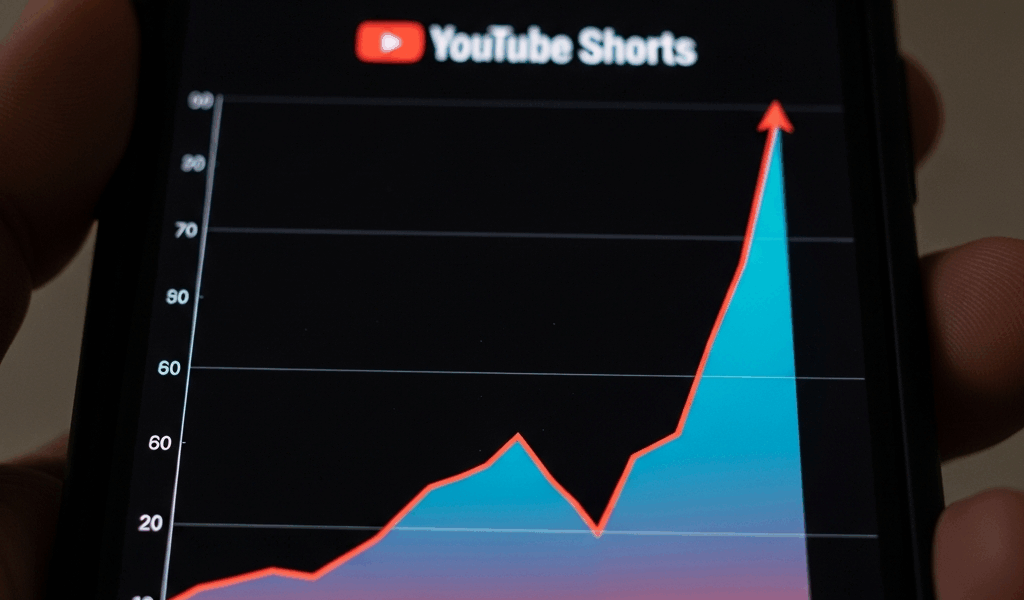
A healthy curve looks roughly like this: maybe 100–500 views in hour one, exponential growth through hours 6–12, a peak somewhere between the 24- and 36-hour mark, then a natural drop. That decline is normal. Expected, even. Views falling 30–50% after peak is completely fine — that’s the video exhausting its initial audience pool.
Going from 50,000 views to 51,000 views over the following 72 hours, though? That’s not a natural decline. That’s YouTube pulling the plug on distribution entirely.
The Algorithm Stopped Pushing Your Short for a Reason
Here’s what most creators get completely backwards: YouTube doesn’t stop promoting your Short because of the video itself. It stops because of how the audience responded to it. Big difference.
Three core metrics get watched during that first 24–48 hours. Average percentage viewed — how much of your Short the average person actually watches before swiping. Engagement ratio — likes and comments measured against total views. And the audience retention graph inside YouTube Studio, which shows you the exact second people bail.
Dip below YouTube’s threshold on those metrics — specifically your channel’s own typical performance baseline — and the algorithm assumes the Short isn’t resonating broadly. So it stops spending distribution budget on it. This isn’t punishment. It’s math. The platform is protecting its own recommendation accuracy by cutting losses fast.
Here’s the part that trips people up: 50,000 views feels like success. But if 60% of those viewers swiped away within the first second, YouTube logged that as a failure. The absolute number means almost nothing. Efficiency is everything.
Five Reasons Your Short Peaked and Died
1. The Loop Is Broken or Weak
Rewatch value gets Shorts promoted. Watch-once-and-forget doesn’t. If your average percentage viewed is sitting below 70%, you’re losing people before the natural ending point — and YouTube notices.
Rewatch value almost always lives in the first two seconds. A hook strong enough, or satisfying enough, that someone watches again immediately. Are you delivering tension, curiosity, or a visual payoff fast enough? If the answer is no, remake the Short with a noticeably more aggressive hook and repost it as a brand new upload. Don’t edit the existing one. Start fresh.
2. Wrong Audience Got the Initial Push
Probably should have opened with this section, honestly. YouTube distributes first to your subscribers, then expands outward. If those first 500 views came from an audience misaligned with your Short’s topic, the algorithm sees a mismatch and stops expanding distribution entirely.
I’m apparently a creature of habit and cross-posting works for me while topic-jumping never does — learned that the hard way on a fitness channel where I uploaded a productivity Short to subscribers who came for workout content. The numbers cratered. Don’t make my mistake. Post content that matches the audience you’ve already built, not the audience you’re hoping to attract eventually.
3. Thumbnail or First Frame Caused False Clicks
Shorts don’t use thumbnails the traditional way, but that first frame still appears as a preview in feeds. A shocked expression leading into mediocre advice. A face that doesn’t match what the video actually delivers. People click expecting one thing, get something different within 1–2 seconds, and swipe.
YouTube sees that pattern and essentially flags your Short as misleading. That’s what makes the first frame so critical to us Shorts creators — it’s your real thumbnail whether you treat it that way or not. Make sure it honestly previews what’s happening in the next three seconds.
4. Posting Time Killed Momentum
Post at 2 a.m. when your audience is asleep and your Short spends six hours collecting weak engagement signals before anyone who actually follows you shows up. By the time your subscribers woke up and started watching, the algorithm’s initial testing window had already mostly closed.
That was enough to sink an otherwise solid Short — I watched it happen once and it was genuinely frustrating to diagnose in hindsight. Check YouTube Studio analytics for your peak traffic windows. Post then. Not whenever it’s convenient for your upload schedule.
5. You Cannibalized Your Own Video
Post two similar Shorts within the same two-week window and YouTube may distribute both briefly, then pull back on the newer one — the older Short is already capturing that specific audience segment. The algorithm doesn’t double-promote the same idea to the same people.
Track what you’ve posted recently. Avoid repeating the same hook, topic, or format within 10–14 days. Simple rule, easy to forget when you’re posting consistently.
How to Revive a Short That Already Peaked
Once a Short is dead, the algorithm’s decision on that specific upload is essentially final. But you can inject new signals around it — at least if you’re willing to put in some actual effort rather than just waiting.
Update the title and description with keywords you weren’t targeting originally. This won’t directly revive the Short, but it can trigger a small secondary distribution wave to a different audience segment. Share it to your Community posts, TikTok, Instagram Reels, wherever your audience exists outside YouTube — fresh engagement signals from external sources are readable by the algorithm. Then rebuild the Short entirely. Same core concept, stronger hook, sharper value, better pacing. Repost as a new upload. You get another testing window with an improved version of the same idea.
What you genuinely cannot do is convince YouTube to reverse its decision on a dead upload. That time is gone. Move forward.
What to Do Differently on Your Next Short
So, without further ado, let’s dive into the actual prevention side — because that’s where the real value is anyway.
Hook hard within the first two seconds. Not a face. Not a text overlay. A concrete reason someone should keep watching right now. Make sure your topic matches the audience already subscribed to your channel, not some hypothetical future audience you’re trying to build. Upload when your subscribers are actually online and awake — not just whenever your video is ready.
Test one variable at a time. Change the hook. Then evaluate. Don’t change the hook and the topic and the posting time simultaneously — you’ll never know what actually moved the needle.
Your action today: open YouTube Studio right now and pull the average percentage viewed on your last five Shorts. Any number below 65% is your problem in plain sight. Write down which Short had the lowest percentage — then ask yourself one honest question: did people leave at the hook, or later? Start there on your next upload. That single data point will tell you more than another hour of reading algorithm theory ever will.




Stay in the loop
Get the latest make video short updates delivered to your inbox.